
ALPS LAB / BLOGS
Cognizer: The Next Evolution of the Agent
Beyond execution: AI that knows what’s worth pursuing
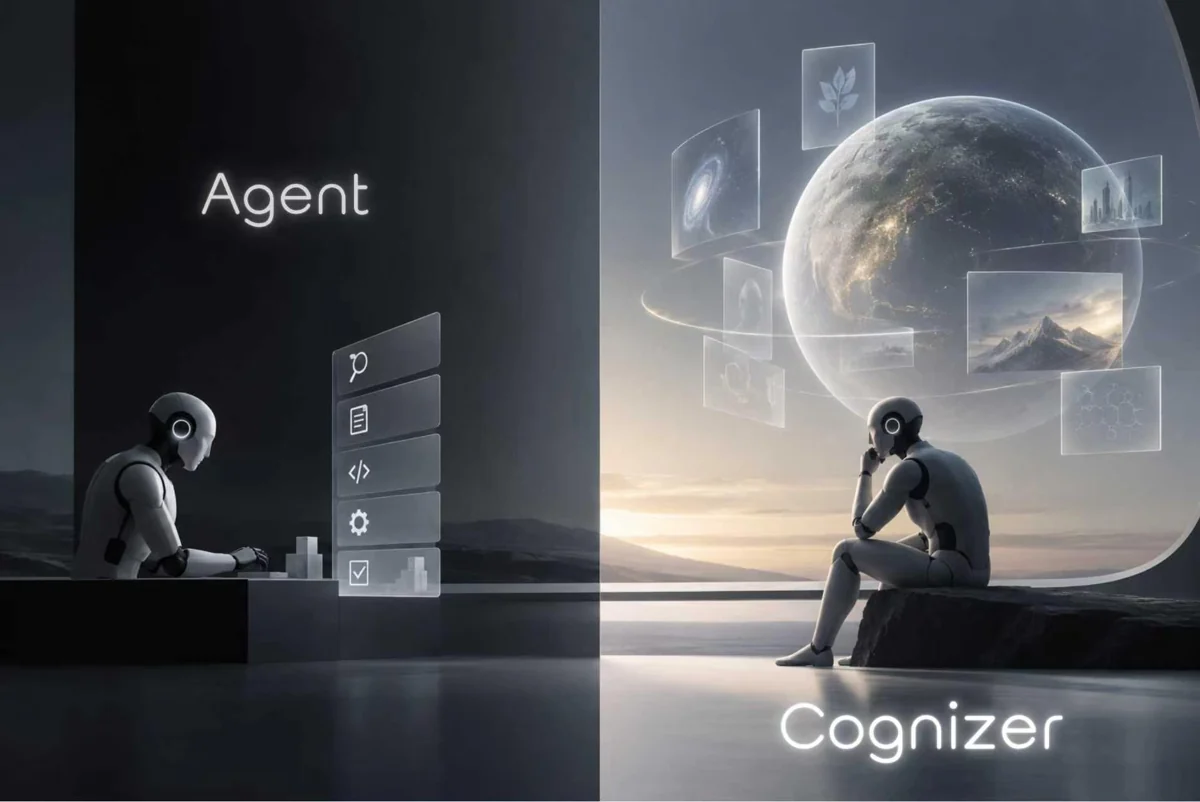
AI agents can now search, reason, use tools, and execute complex multi-step workflows.
But capability to execute is not the same as expert judgment about what to pursue.
Top experts don’t just solve problems better.
They know:
- which problems matter.
- which evidence counts.
- which assumptions to challenge.
- which direction is worth betting on.
- when to pivot.
- and sometimes they sense where to look next — even before they can fully explain why.
That’s cognition.
And we believe it’s the next frontier for AI agents.
Meet the Cognizer
We call an agent with this richer form of cognitive capability a Cognizer.
Cognizer = Agent + Expert-level cognitive capability
It is not a fundamentally separate system from an agent—it is an agent built to reach expert-level cognitive performance.
It evaluates purposes and tradeoffs, identifies high-impact questions, picks the right approach, forms testable hypotheses, weighs evidence, and learns systematically from experience.
AGENT
Goal → Plan → Act → Result
COGNIZER
Understand → Judge → Explore
→ Act → Evaluate → Learn → Improve
CORE SHIFT
Not just: “What should I do next?”
But also: “What is worth thinking about?”
Cognizer = Agent + Expert-level cognitive capability
Figure 1. Core shift from Agent to Cognizer.
Its cognitive loop looks like:
Understand → Judge → Explore → Act → Evaluate → Learn → Improve
The goal is not simply to make an agent more autonomous.
It is to make the agent better at making expert-level judgments about how to allocate intelligence, how to approach problems, and when to change direction.
From Execution to Cognition
A useful way to frame many current agent workflows is:
What should I do next?
A Cognizer asks additional questions:
What should I think about?
Why does it matter?
What should I believe?
How should I approach it?
When should I change direction?
These questions are part of what experts routinely consider before and during execution.
Three Core Cognitive Capabilities
Taste
Which questions are worth attention?
Judgment
What evidence, assumptions, and trade-offs matter?
Intuition
Which direction may be promising before the full answer is clear?
Figure 2. Three core capabilities of a Cognizer.
Taste: Know which problems are worth solving
Taste is the ability to recognize which questions are important.
Experts don’t spend equal effort on every possible problem.
They develop a sense for what is promising, consequential, elegant, or potentially transformative.
Judgment: Weigh evidence, assumptions, and tradeoffs
Judgment evaluates what’s plausible, what’s worth acting on, and what the real tradeoffs are.
It doesn’t just check if an answer works—it judges if the problem itself is framed correctly.
Intuition: Spot promising directions early
Intuition is the ability to identify promising directions before a complete explanation is available.
It is not magic.
It is accumulated experience compressed into a decision about where to look next.
A Cognizer should learn these capabilities from expert demonstrations, corrections, disagreements, experiments, failures, and validated outcomes.
Next Cognitive Pattern Prediction: Learning How to Think
Once an agent can evaluate a problem, it can also learn different cognitive patterns for approaching it.
- Problem reframing → change the perspective.
- Easy-to-hard transfer→ apply a method from a simpler problem.
- Multi-path exploration → compare routes.
- Idea integration → synthesize findings.
- Evidence attribution → locate the real bottleneck.
- Research control → focus effort on the most promising direction.
- Cross-domain analogy → borrow insight from another field.
We call this capability Next Cognitive Pattern Prediction (NCPP) — Learning how to think.
Given the current goal, evidence, and progress, what is the most useful cognitive pattern to use next?
This is not next-token prediction
This is a fundamentally different prediction target from standard LLMs.
Prediction target | What it does | |
|---|---|---|
LLM | Next token Prediction | Predicts the next word in a text sequence, based on prior context. |
Cognizer | Next Cognitive Pattern Prediction (NCPP) | Selects or generates the next useful reasoning strategy, based on goal, evidence, and progress. |
Figure 3. Different prediction targets: next-token prediction versus Next Cognitive Pattern Prediction
One-line difference: LLMs predict the next word. Cognizers predict the next breakthrough.
NCPP is not a replacement for LLMs—it’s a higher cognitive layer that sits on top of underlying models and directs how they’re used.
A Cognizer learns how to think. Expert supervision at key decision points helps develop its judgment, taste, and intuition. Learning from verified experience enables it to refine these capabilities and provides the mechanism for going beyond expert performance.
Cognitive Scaling: A Path Toward ASI
Scaling models, data, and compute continues to expand AI capabilities. Cognitive scaling complements this progress by improving how intelligence is directed and refined through experience.
Expert research taste, judgment and intuition remain difficult to replace simply by running more agents in parallel for longer.
Our goal is for Cognizers to learn from verified experience and ultimately surpass experts in taste, judgment, and intuition. We see cognitive scaling as a path toward artificial superintelligence (ASI).
The Recursive Self-Improvement Loop
Successful tasks don’t end when the work is done.
Results become experience.
Experience sharpens judgment.
Better judgment leads to better decisions.
Better decisions generate better experience.
This creates a compounding recursive loop: Think → Act → Verify → Learn → Think better
THINK
→
ACT
→
VERIFY
→
LEARN
→
THINK BETTER
Figure 4. The recursive self-improvement loop for Cognizer
This is how Cognizer recursively self-improves. The long-term goal isn’t just a larger model or better tool use. It’s a system that gets better at choosing how to use its own intelligence.
Beyond Agents: Expanding Human Capability
This is not about replacing human judgment. It’s about amplifying it.
The purpose of a Cognizer is to expand human understanding and creation.
Humans retain full authority: to understand the basis of decisions, challenge the system, test alternatives, redirect goals, and stop or replace it at any time.
The ambition is not:
AI decides what humanity should want.
It is:
AI helps humans see what they could not see before.
Imagine a scientific agent that does not merely run experiments, but recognizes that the most important experiment has not yet been proposed.
Imagine an engineering agent that does not simply optimize a design, but realizes the design problem itself is incorrectly framed.
Imagine a strategic agent that knows when the obvious opportunity is not the important one.
That’s the Cognizer direction.
The future of AI won’t be measured only by how much agents can do. It will be measured by how well they decide what’s worth doing, what’s worth thinking about, and when to change direction.